
Palm oil
Within the palm oil supply chain, we have set a range of measures and targets in alignment with the FPCoA roadmap. Under the first element of this roadmap – focusing on our own supply chain –, the action plan aims to enhance transparency by ensuring traceability at least to the country of origin. At the same time, we want to ensure that palm oil production does not contribute to human rights violations, deforestation or conversion of high conservation value (HCV) ecosystems, including high carbon stock forests and peatland areas.
Our goal is to ensure the sustainable origin of the palm oil used in private brand and perishable products across all our banners. Accordingly, we are committed to guaranteeing that this palm oil is free from deforestation or HCV ecosystems conversion. To meet this target, two cut-off dates have been defined to ensure compliance with the criteria of no-deforestation and no-conversion:
November 2005 – Applicable to primary forests and areas critical for the protection of HCV ecosystems;
15 November 2018 – Applicable for HCV and high carbon stock forest.
Progress in 2025
In 2025, 100% of our palm oil consumption in Private Brand and perishable products amounted to 92,473 tonnes. The 19.1% increase in palm‑oil consumption is primarily explained by the change in the composition of edible oils, reflecting a higher share of palm oil and a reduced use of soy, particularly at Ara – approximately 90% of the total palm oil volume is used in cooking vegetable oils, a product that is especially relevant to consumers in Colombia.
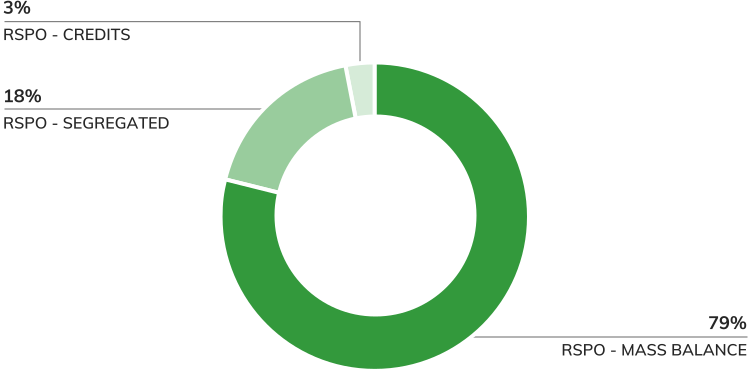
In Poland and Portugal, 100% of the palm oil used in Private Brand and perishable products was certified by RSPO (Roundtable on Sustainable Palm Oil), with the vast majority certified under the Mass Balance and Segregated schemes.
RSPO schemes in Portugal and Poland (2025)
Although Colombia is one of the world’s largest producers of palm oil, the proportion of locally produced oil certified by RSPO remains low.
This constraint, combined with our commitment to prioritise local sourcing – as set out in our Sustainable Sourcing Policy, with the aim of reducing carbon emissions associated with transport and promoting local development –creates a particularly challenging context for increasing the share of RSPO-certified, Colombian‑produced palm oil incorporated into our products.
To address this challenge, Ara has been part, since 2021, of the “Acuerdo de Voluntades para la Deforestación Cero en la Cadena de Aceite de Palma en Colombia” (Voluntary Agreement for Zero Deforestation in the Palm Chain in Colombia), a government‑led initiative aimed at ensuring that palm oil used in the country does not contribute to deforestation. The agreement brings together various civil‑society organisations – including the RSPO, Proforest, Tropical Forest Alliance and WWF – and promotes collective actions to improve traceability down to the plantation level, thereby ensuring that local production is not associated with ecosystem conversion. The initiative also seeks to ensure that palm oil imported into Colombia holds a sustainability certification, such as RSPO. This framework has gradually strengthened monitoring and verification mechanisms related to deforestation associated with palm oil in Colombia.
In 2025, 90% of the palm oil used in Ara’s Private Brand and perishable products originated from Colombia, representing an increase of 15 p.p. compared to 2024. Of this volume, approximately 41% was RSPO certified (25 p.p. less than in 2024). During the same period, we were able to trace to the plantation region 94% of the Colombian palm oil used in Private Brand and perishable products (a decrease of 1 p.p. compared to 2024). This level of traceability enabled the identification of sourcing from the Departments of Norte de Santander, Santander, Bolívar, Cesar, Magdalena, Meta and Casanare, located across the country’s four producing zones (Central, Eastern, South-Western and Northern Zones), and from 18 processing mills operating in Colombia. However, only 0.75%1 of the deforestation identified by Colombian public authorities is associated with palm oil.
The combination of high traceability levels, progress in RSPO certification and the low deforestation rate associated with palm oil supports the robustness of our DCF strategy for this commodity in Colombia.
Regarding the palm oil used in Ara’s Private Brand and perishable products that is sourced outside Colombia, we will continue to work closely with suppliers to increase RSPO certification levels. This effort is supported by our commitment to ensuring that all imported palm oil is DCF.
Assuming that:
for countries considered at risk of deforestation and conversion, physical certification schemes up to the “Segregated” level are considered DCF;
6% of our Colombia‑origin consumption carries a potential deforestation risk, reflecting a conservative approach given that it was not possible to trace 100% of consumption to the plantation level;
the deforestation rate associated with Colombian palm oil (0.75%), as identified by public authorities, has been applied to 94% of our consumption (i.e. the share we were able to trace to the plantation area of origin);
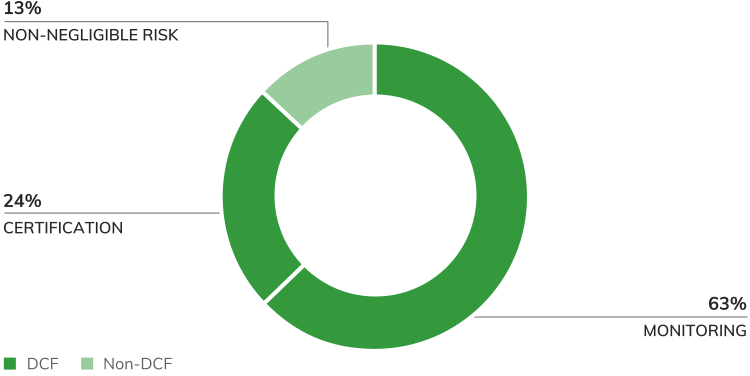
we estimate that 68% (62,885 tonnes) of our total palm oil consumption in 2025 was free from deforestation and the conversion of High Conservation Value ecosystems. Of this, 6% (4,067 tonnes) is covered by DCF physical certification schemes, while 94% (58,817 tonnes) is managed through traceability and DCF verification.
Breaking down our total consumption – 81,323 tonnes in direct sourcing and 11,150 tonnes in complex sourcing – we find that:
within direct supply chains, 73% of the volume (58,963 tonnes) meet the DCF criteria;
within complex supply chains, 35% of the volume (3,921 tonnes) align with our DCF assumptions.
In the case of direct supply chains, the fact that 73% of the volume meet DCF criteria largely reflects the predominant use of palm oil is as a direct ingredient in edible oils at Ara. In complex supply chains, DCF-aligned volumes are more limited, primarily dure to higher value chain fragmentation and related upstream traceability constraints, as well as challenges in securing RSPO‑certified segregated palm oil for derivatives, which are widely used as ingredients in processed products.
These figures are based on the new DCF calculation methodology developed by the FPCoA for palm oil, applicable from 2024. This method considers physical certification schemes up to the “Segregated” level as DCF-compliant. However, when including volumes of palm oil certified under the RSPO “Mass Balance” level, 80,842 tonnes (around 87% of our total consumption in 2025) would be classified free from deforestation and the conversion of High Conservation Value ecosystems.
The inclusion of the “Mass Balance” certification model in the DCF calculation reflects the investment and commitment of our Private Brand and perishable suppliers, as it requires additional financial and operational requirements. These efforts demonstrate their commitment in reducing deforestation and conversion risks, while upholding human rights and preserving biodiversity across the palm oil supply chain. By acknowledging these contributions, we also reinforce progress towards more responsible production practices aligned with internationally recognised sustainability standards.
DCF Status - Palm Oil (2025)
We will continue to work to increase the traceability of palm oil volumes, particularly – where feasible – on achieving traceability down to plantation level, so that we can verify that production is not associated with deforestation or the conversion of HCV ecosystems.
In 2025, we achieved an average score of 8.2 in the RSPO Shared Responsibility Scorecard, which represents an improvement of 0.8 points compared to 2023 – and a performance above the retail sector average (4.6). The RSPO assessment considers five dimensions: transparency and legality, environment, social issues, sourcing and fulfilment of certification targets.
Further detail on our progress in palm oil is available in our responses to the Roundtable on Sustainable Palm Oil’s Annual Communication on Progress.
Engagement with suppliers and traders
As part of Element 2 of the roadmap – engagement with suppliers and traders – we remain committed to transparently communicate our expectations and initiatives to all those involved in our supply chain.
In 2025, we continued the work initiated in 2014 to map the presence of palm oil in Private Brand and perishable products. This process involves the annual distribution of surveys to our direct suppliers to collect information on the type of certification applied to the commodity and the origin of primary production, at least at national level.
We regularly communicate our commitments, progress and policies related to the preservation of forests and evaluate suppliers’ policies and actions to fight deforestation. The goal is to enhance supply chain traceability and mobilise Private Brand and perishable suppliers to adopt concrete commitments and initiatives aligned with the FPCoA roadmap guidelines.
In 2025 we reinforced this work with our main suppliers, who accounted for more than 80% of our consumption, and have identified their main sources of supply, importers, refineries where palm is processed and the volume of certified raw materials (see mills list here). We were able to identify the traders and upstream suppliers of our direct suppliers who are responsible for more than 70% of our palm oil consumption from countries at risk of deforestation and conversion. Of the main traders identified (AAK, BASF, Bunge, Croda, IOI Group, Olenex, Oleoflores, Wilmar) that accounted around 10% of our palm oil consumption in 2025, six were assessed by CDP and were rated A (17%), A- (33%) and B (50%) in the Forests programme.
By the end of 2026, and together with our main direct suppliers, we intend to increase traceability at the level of the traders involved in the supply chain and disclose information on their performance in fighting deforestation and conversion of natural ecosystems. We will also continue to involve the most relevant direct suppliers in interactions and workshops, to identify their commitments to fight deforestation and conversion and raise awareness about their alignment with the objectives we have set for our palm oil supply chain.
In 2025, we maintained an active role in multi-stakeholder initiatives at national level:
in Poland, through Biedronka’s participation in the Polish Coalition for Sustainable Palm Oil (PKZOP), the goal of certifying 100% of the palm oil (e.g. RSPO) was achieved;
in Colombia, through Ara, we continued to work towards increasing the certification of palm oil from non-Colombian sources, as defined in the “Voluntary Agreement for Zero Deforestation in the Palm Chain in Colombia”.
1 Data disclosed in the analysis of deforestation levels associated with palm‑oil production, carried out in 2023 by IDEAM – the Institute of Hydrology, Meteorology and Environmental Studies – and the Colombian Ministry of Environment.